// Introduction
Bridging the Discovery Gap
As part of my Computing Science studies at Thompson Rivers University (TRU), I've collaborated on a research project aimed at transforming how students learn microbiology. Traditional methods often struggle to convey the dynamic, microscopic world, hindering engagement and making it difficult to connect abstract theory with the living history of scientific discovery.
Our project, "Revolutionizing Microbiology Education," tackles this head-on by developing an interactive virtual discovery platform that leverages technology to bring historical experiments and core concepts to life — allowing students to actively engage with the material in ways previously impossible in a traditional classroom setting.
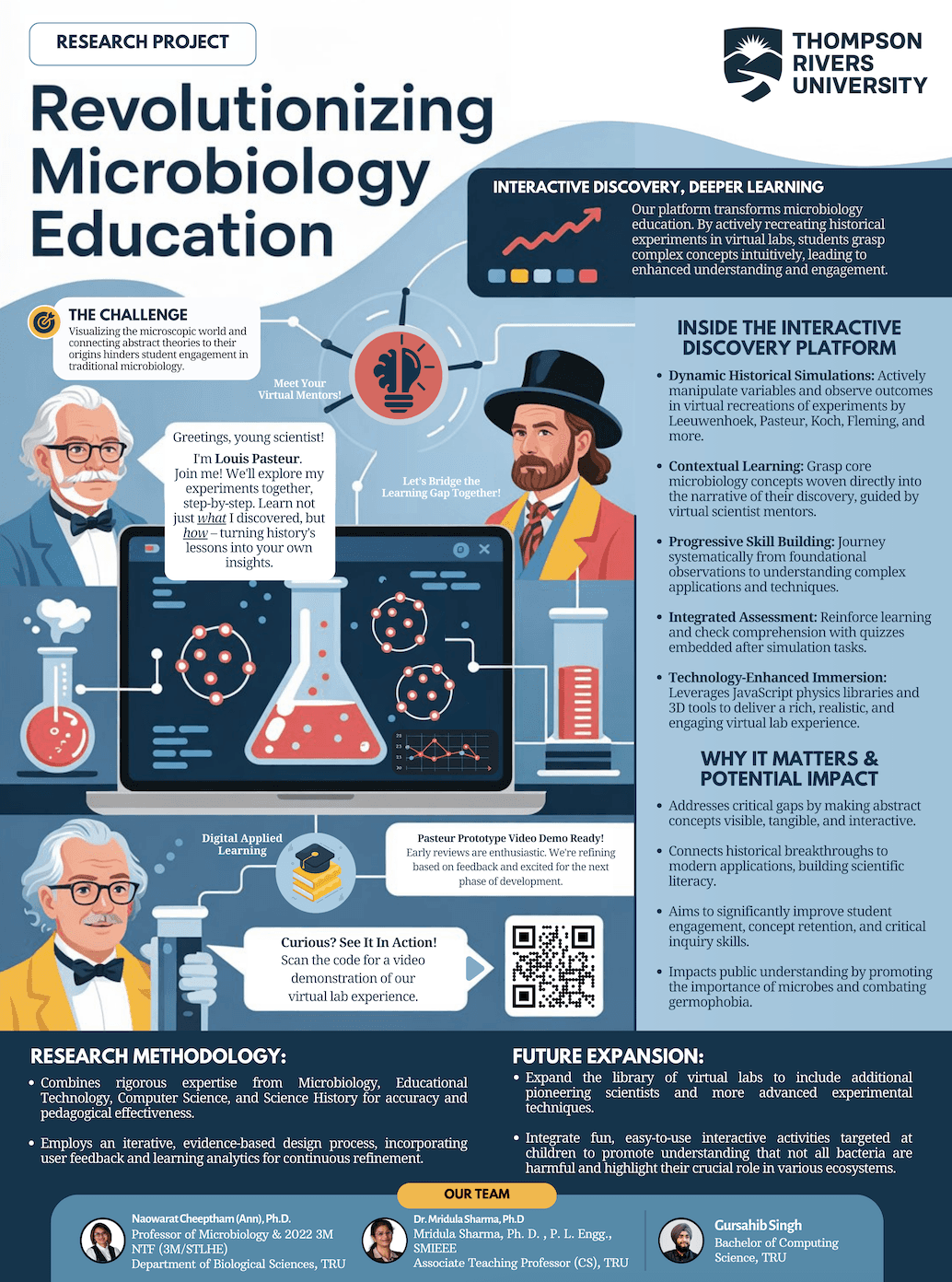
↑ Comprehensive research poster detailing the educational framework
// Context
Visualizing the Invisible
Microbiology involves concepts that are abstract and invisible to the naked eye. Visualizing the microscopic world and connecting foundational theories — such as those developed by Pasteur, Koch, Leeuwenhoek, and Fleming — to their historical origins can be profoundly difficult for students. Without that context, the "why" behind each discovery is lost.
This disconnect often hinders engagement and makes it challenging to grasp complex biological processes intuitively. Our goal is to overcome these hurdles by placing students directly inside the moment of discovery, rather than presenting conclusions detached from their experimental roots.
// Innovation
Interactive Storytelling
We are developing an interactive platform that reimagines microbiology education. At its core, it allows students to actively recreate historical experiments in virtual labs — effectively stepping into the shoes of Louis Pasteur or Robert Koch. This hands-on approach turns passive learning into active exploration, bridging the gap between abstract theory and tangible understanding.
Narrative-Driven Simulation
By simulating experiments and guiding students through the narrative of discovery with virtual scientist mentors — including a virtual Louis Pasteur who walks learners through his own landmark experiments — the platform helps students grasp complex concepts intuitively, leading to measurably enhanced understanding and engagement.
// Features
Inside the Discovery Hub
Dynamic Simulations
Students actively manipulate variables and observe outcomes in virtual recreations of landmark experiments by pioneers like Leeuwenhoek, Pasteur, Koch, and Fleming — moving beyond passive observation to genuine scientific inquiry.
Contextual Learning
Core microbiology concepts are woven directly into the narrative of their historical discovery, guided by virtual scientist mentors. This ensures pedagogical effectiveness while maintaining the drama and curiosity of the original breakthrough.
Progressive Skill Building
Students journey systematically from foundational microscopic observations to understanding complex applications and modern techniques, scaffolding knowledge in a developmentally coherent sequence.
Integrated Assessment
Quizzes and comprehension checks are embedded directly after simulation tasks to reinforce learning, providing educators with immediate analytics to track student progress and identify areas for intervention.
3D Lab Environments
Utilizing JavaScript physics libraries and 3D rendering tools for a rich, realistic, and immersive virtual lab experience that accurately models the physical behavior of microscopic phenomena.
Technology-Enhanced Immersion
The platform integrates real-time physics simulation with narrative-driven design, creating an environment where scientific accuracy and engaging storytelling reinforce one another rather than compete.
// Research
Multidisciplinary Foundations
Our research methodology draws on rigorous expertise from four distinct disciplines: Microbiology, Educational Technology, Computer Science, and the History of Science. This cross-disciplinary composition ensures the platform is simultaneously scientifically accurate, pedagogically sound, and technically robust.
From a technical standpoint, the simulation layer is built on JavaScript physics libraries and 3D rendering tools, enabling realistic interactions with microscopic environments. On the research side, we employ an iterative, evidence-based design process — continuously incorporating direct user feedback and learning analytics to refine both the content and the experience across development cycles.
// Significance
Beyond the Classroom
This platform has the potential to address critical gaps in science education that traditional methods cannot resolve. By making abstract biological concepts visible, tangible, and interactive, it fundamentally changes the student's relationship with the subject matter.
- Connects historical breakthroughs to their modern applications, building genuine scientific literacy rather than rote memorization.
- Aims to measurably improve student engagement, long-term concept retention, and the development of critical inquiry skills.
- Promotes a balanced and accurate public understanding of microbes — combating germophobia by illustrating the essential and beneficial roles bacteria and microorganisms play in human health and ecosystems.
- Opens access to high-quality, experiential microbiology education regardless of institutional resources, making advanced lab-style learning equitable and scalable.
// Roadmap
Future Expansion
With a working Pasteur experiment prototype already complete and receiving enthusiastic early reviews, we are actively refining the initial module based on structured feedback and preparing for the next phase of development.
Expanded Laboratory Library
Our roadmap includes expanding beyond the initial Louis Pasteur simulation to encompass additional pioneering scientists and their landmark discoveries — building a comprehensive virtual laboratory curriculum that covers the full arc of foundational microbiology.
Educational Outreach
Beyond university students, we aim to adapt the platform's interactive modules into accessible, fun activities designed for children — engaging younger demographics and fostering an early appreciation for biological sciences and the beneficial roles microbes play in daily life.
// Progress
See It In Action
A working video demo of our Louis Pasteur experiment prototype is complete and has already received enthusiastic early reviews from both faculty and students. The prototype demonstrates the core simulation loop — from setting up the experiment environment to observing outcomes guided by a virtual Pasteur mentor — and validates the platform's core pedagogical approach.
Pasteur Prototype — Video Demo Ready
Early feedback on the Pasteur experiment prototype has been enthusiastic. We are actively refining the module based on structured user feedback and are excited to move into the next phase of development — expanding the lab library and preparing for broader academic evaluation.
// Collaboration
The Research Faculty
This project is a collaborative effort spanning Microbiology, Computing Science, and Educational Technology. I am grateful to work alongside dedicated faculty members whose expertise shapes every dimension of the platform.
Dr. Naowarat Cheeptham (Ann), Ph.D.
Professor of Microbiology & 2022 3M National Teaching Fellow (3M/STLHE), Department of Biological Sciences, Thompson Rivers University.
Dr. Mridula Sharma, Ph.D., P.L. Engg., SMIEEE
Associate Teaching Professor, Department of Computing Science, Thompson Rivers University.
Gursahib Singh
Student Researcher, Bachelor of Computing Science, Thompson Rivers University.
// Closing Thoughts
Looking Forward
Revolutionizing microbiology education through interactive technology is a challenging but incredibly rewarding endeavor. The intersection of historical science, modern pedagogy, and immersive simulation opens possibilities that static textbooks simply cannot offer — and this project sits precisely at that intersection.
We believe this platform has the potential to significantly enhance student learning, foster a deeper appreciation for the microbial world, and democratize access to high-quality science education. I'm proud of the progress made so far and excited about everything still ahead. Stay tuned for further updates as we expand the lab library and move into broader academic evaluation.