// Recognition
1st Place Winner - $4,000 Scholarship
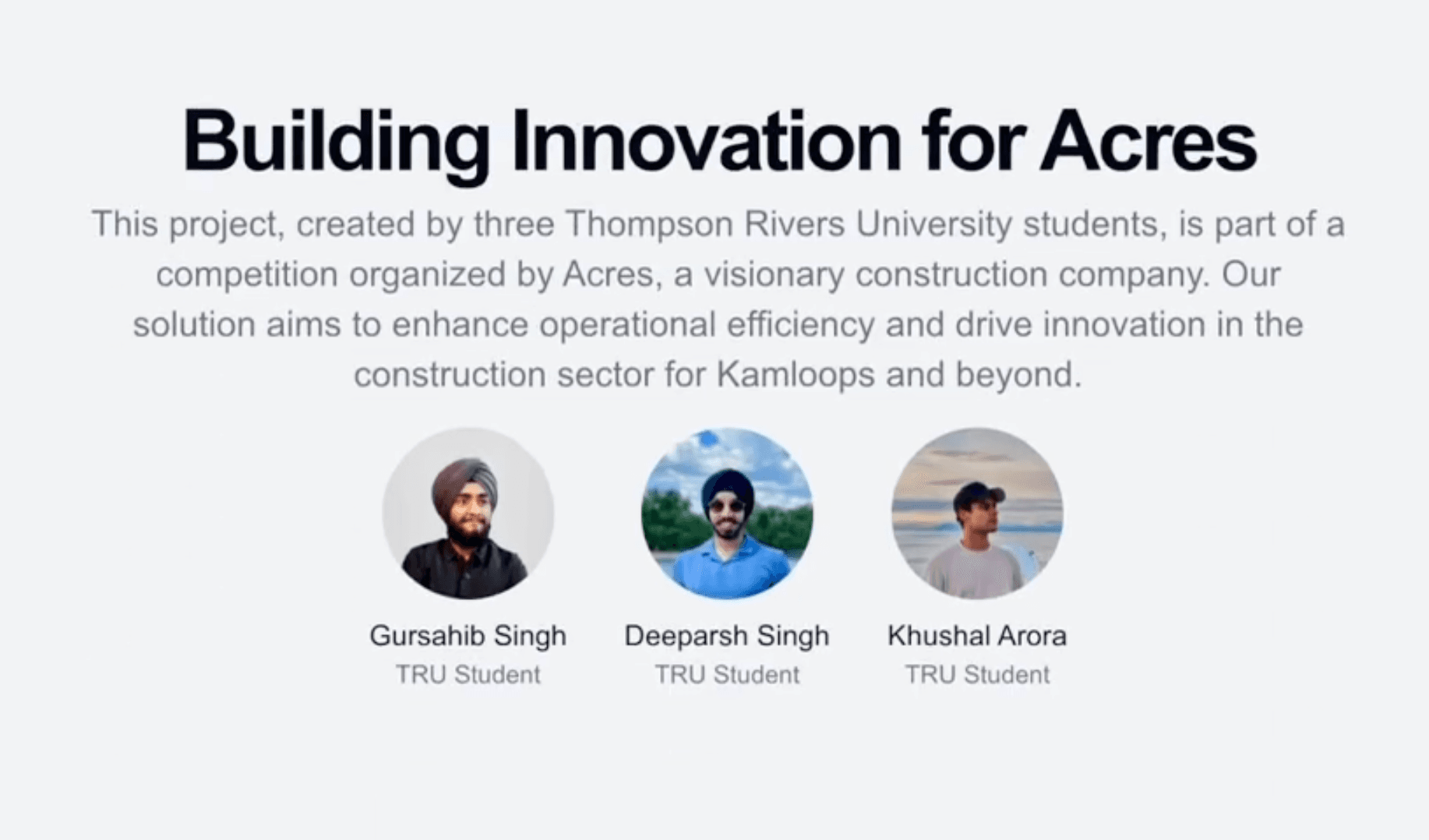
Awarded at the ACRES Competition, Thompson Rivers University (December 2024) for exceptional innovation and project execution.
Revolutionizing site operations through AI
As Team Lead, I spearheaded a team of three TRU Computing Science students, working alongside Deeparsh Singh and Khushal Arora, to develop ACRES as a platform that could revolutionize construction site operations through better safety, efficiency, and project coordination.
We built a comprehensive platform featuring automated PPE checks using computer vision, an intelligent AI chatbot for secure real-time site data access, and dynamic task management powered by agentic AI workflows.
The result was an integrated system where safety monitoring, inventory intelligence, and planning tools worked together instead of living in disconnected operational silos.
↑ Competition winning walkthrough of the ACRES system
// Industry Gaps
The Industry Struggle
Safety Compliance
Manual PPE checks are time-consuming and prone to human error, especially when consistent gear usage must be enforced across multiple sites with different hazards.
Inefficient Data
Inventory tracking and critical site data often rely on manual methods or siloed systems, slowing down real-time decision making and resource allocation.
Complex Coordination
Managing dependencies and multi-phase task updates manually creates significant administrative overhead and can lead to delays or missed steps in dynamic environments.
// Core Pillars
An AI-Integrated Ecosystem
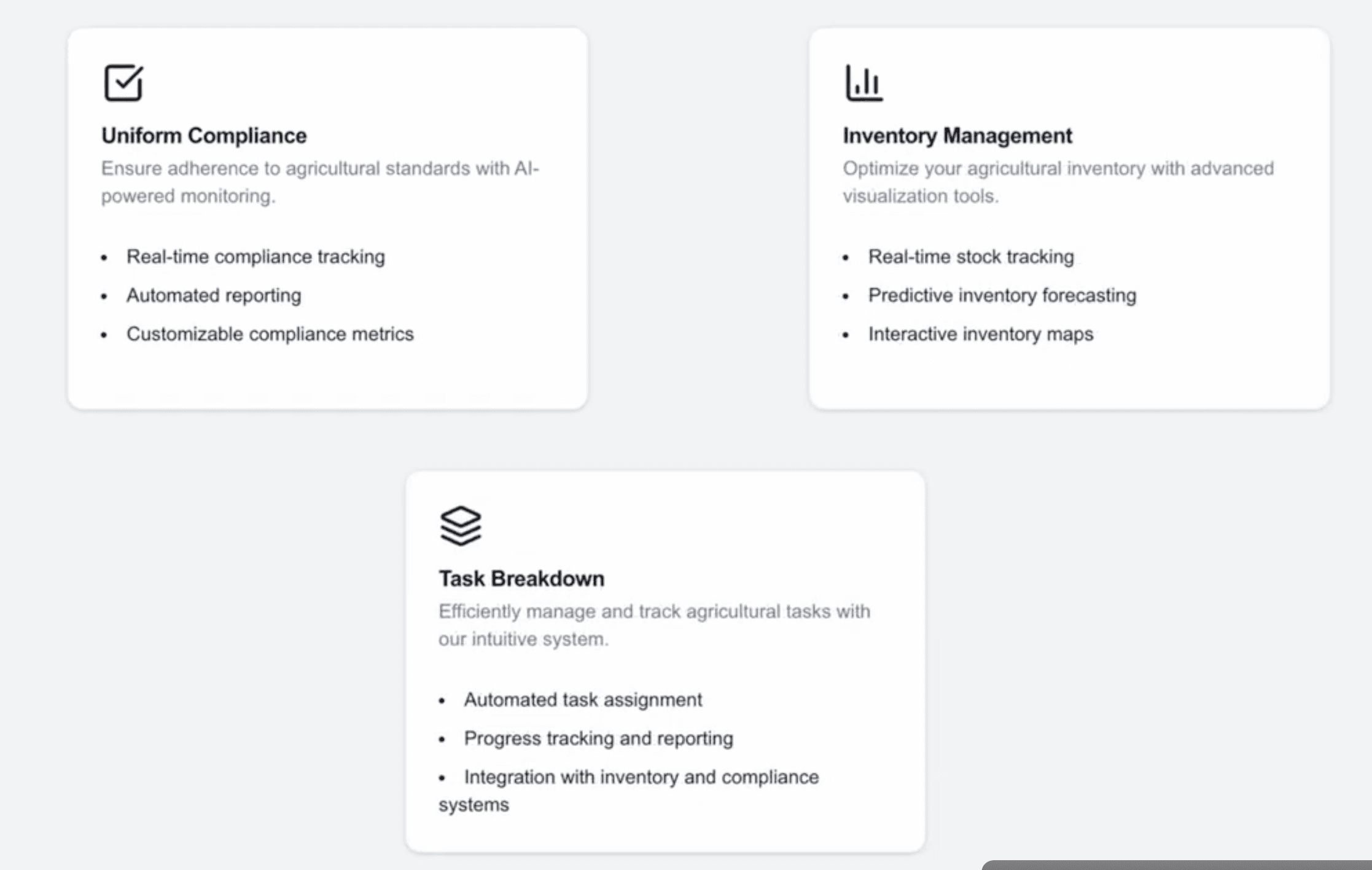
Our solution unified three distinct AI modalities into a single operational interface, ensuring that safety, data, and tasks evolve in lockstep with the physical site state.
- Automated PPE Compliance: AI vision verifies whether workers are wearing the site-specific gear required before entering the work zone.
- Intelligent Inventory Assistant: A natural-language chatbot translates questions into secure SQL and returns live answers from the operational database.
- Dynamic Task Breakdown: Agentic workflows generate structured Kanban-ready tasks and subtasks from project context, documents, and board state.
// Computer Vision
Automated Compliance
Manager Control
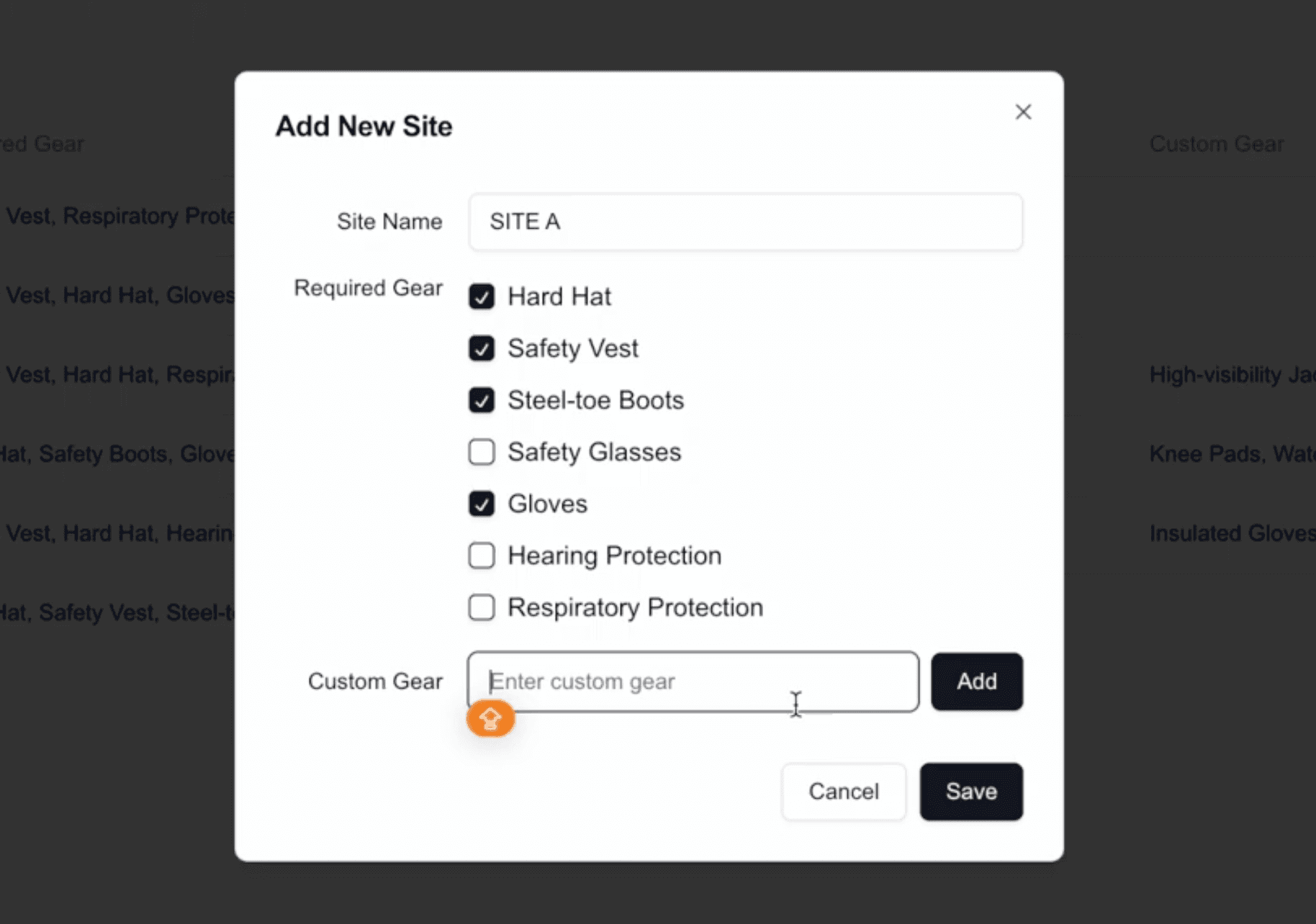
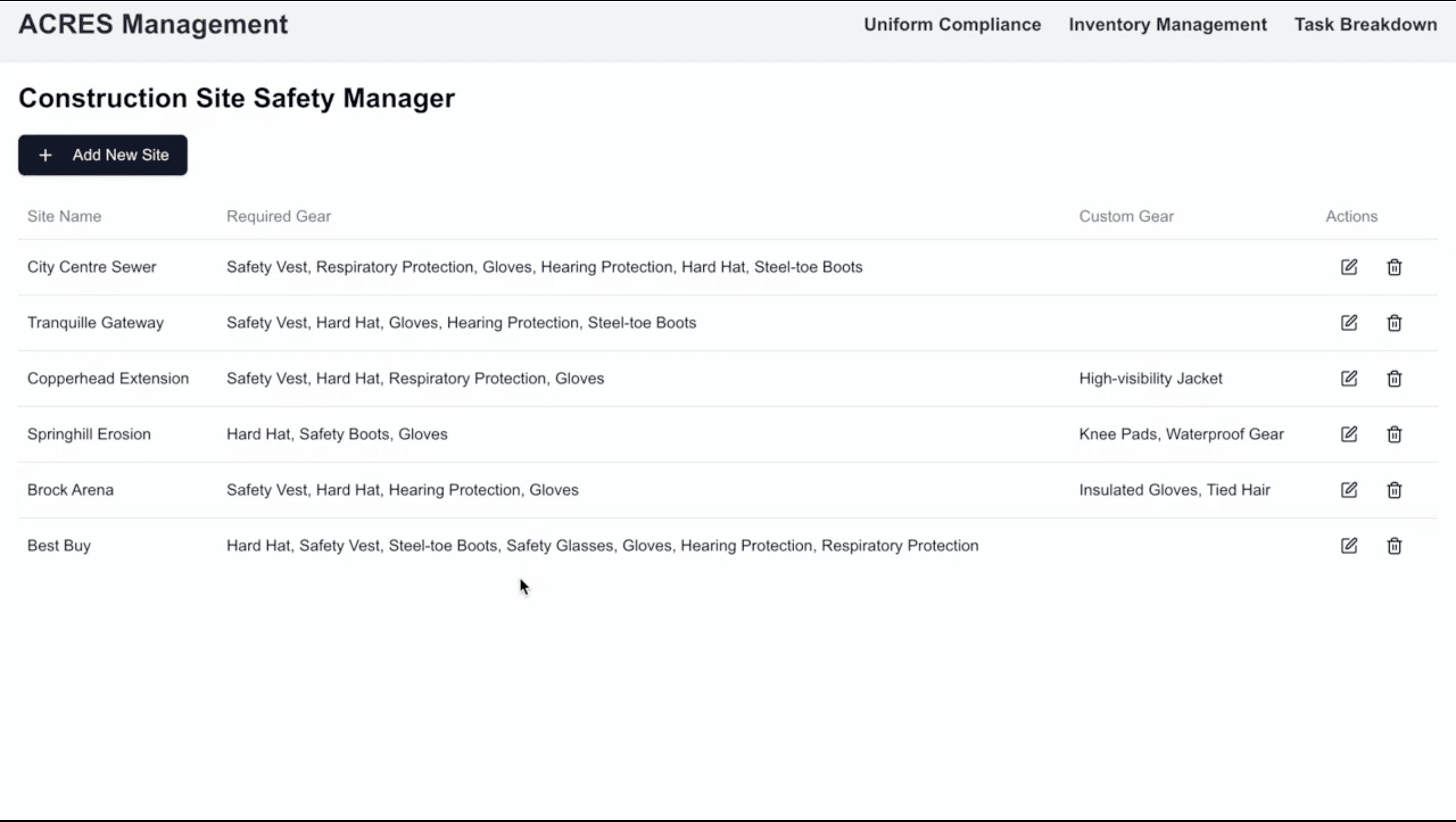
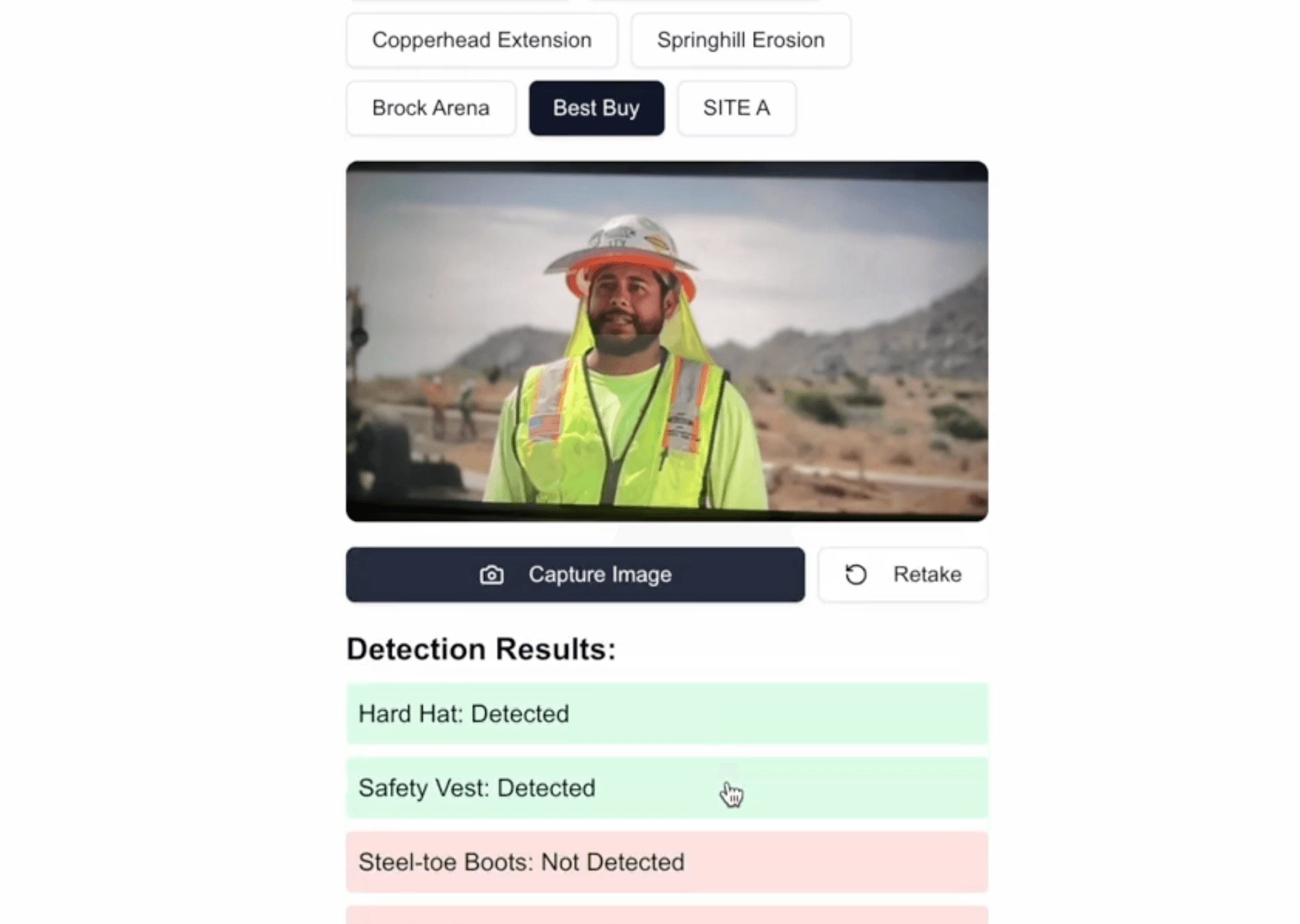
Site managers use a dedicated dashboard to define the mandatory PPE items required for each unique construction site — hard hats, safety vests, steel-toe boots, gloves, and any custom gear dictated by that location's specific hazards. That gives the vision system a precise, site-aware rule set rather than applying a one-size-fits-all standard.
Requirements can be added or modified at any time, keeping the platform in sync with evolving safety protocols and preventing compliance checks from drifting out of date.
Real-Time Detection
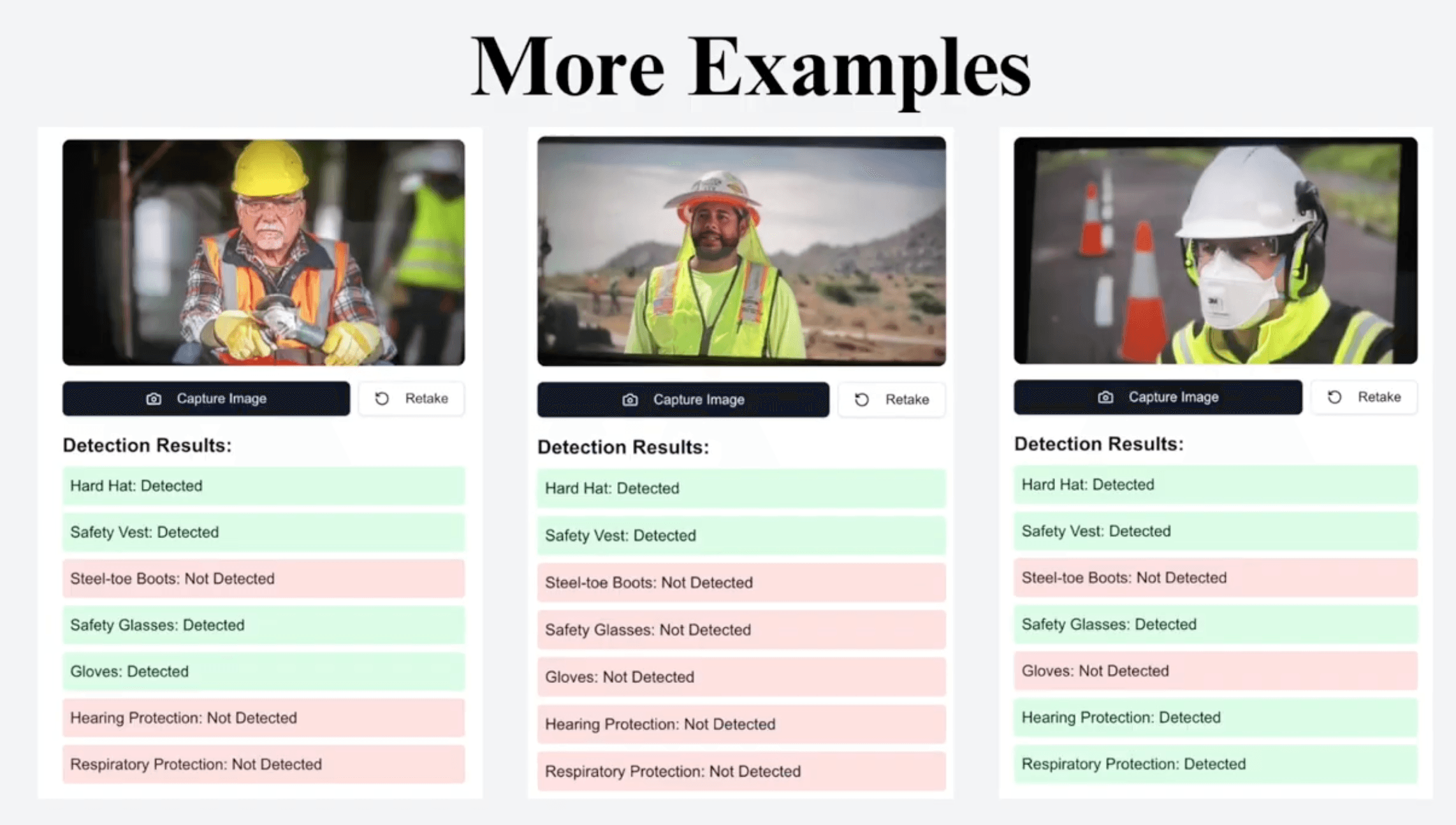
Workers capture an image upon arrival. The computer vision model — fine-tuned on construction site imagery to handle lighting variation and partial occlusions — detects the presence of each required gear item in real time and verifies full adherence instantly.
The interface returns color-coded feedback highlighting detected items in green and missing items in red, so workers can make corrections on the spot rather than waiting on a delayed manual inspection or risking entry without proper protection.
// NLP & SQL
Conversational Data
Natural Language SQL
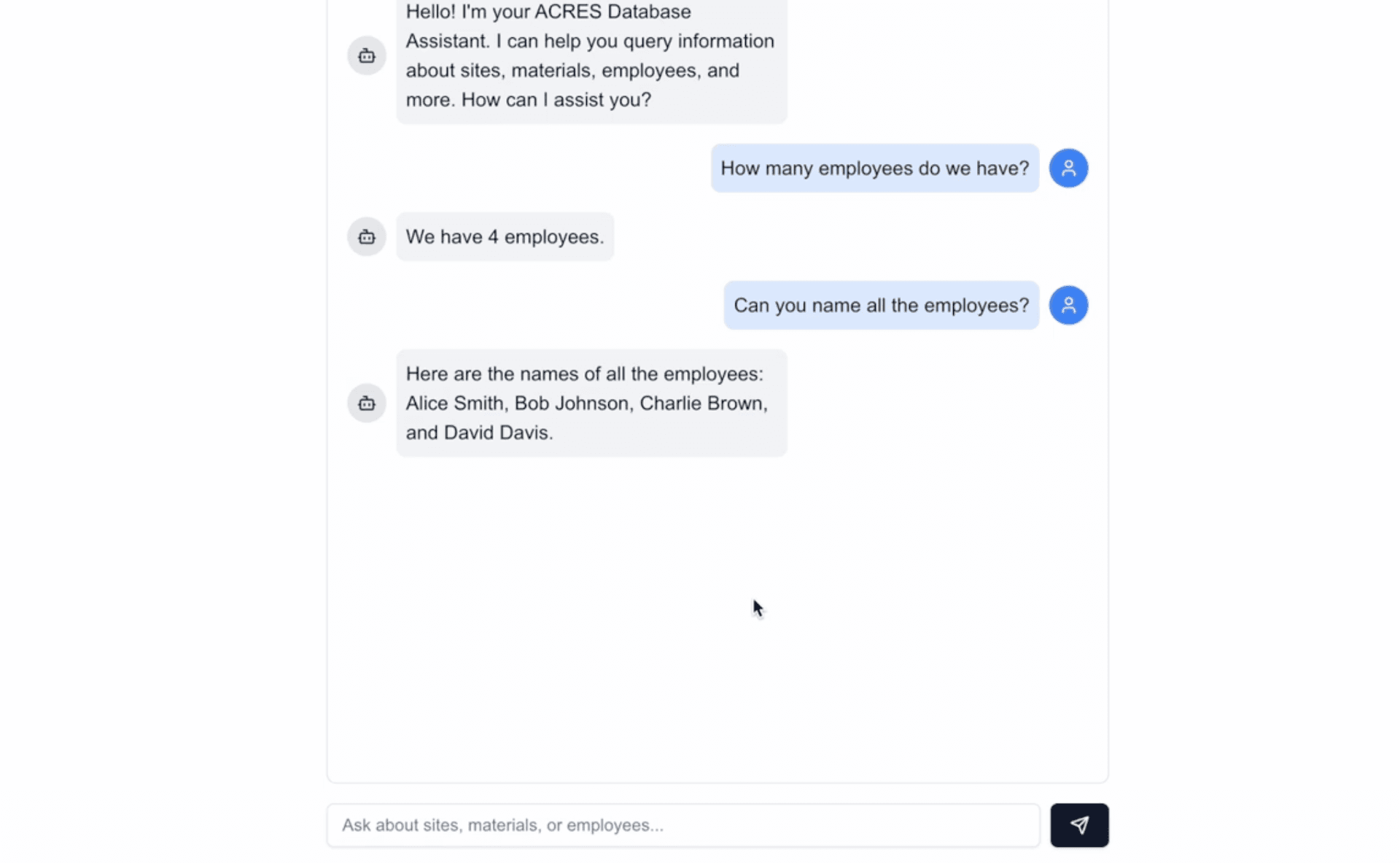
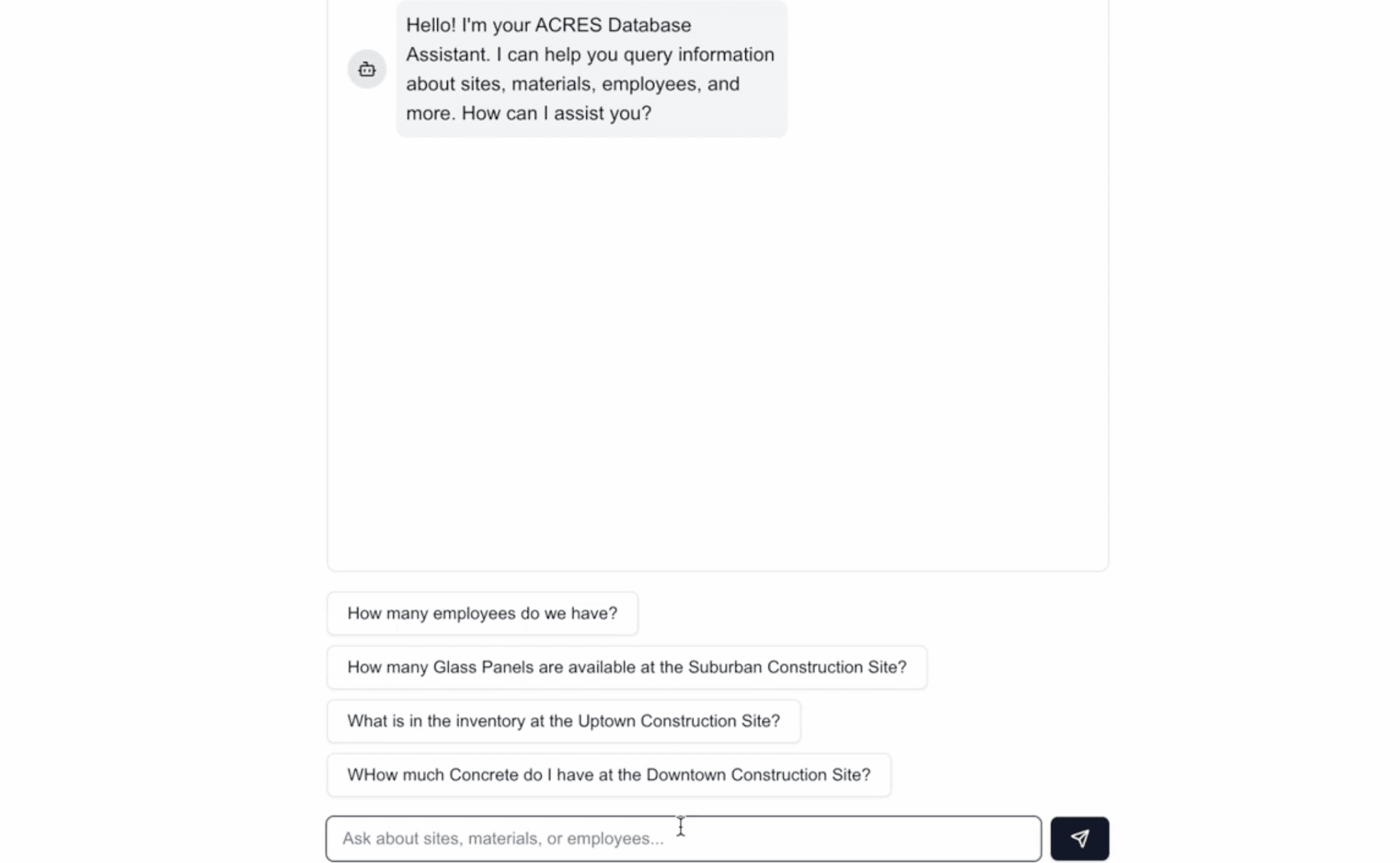
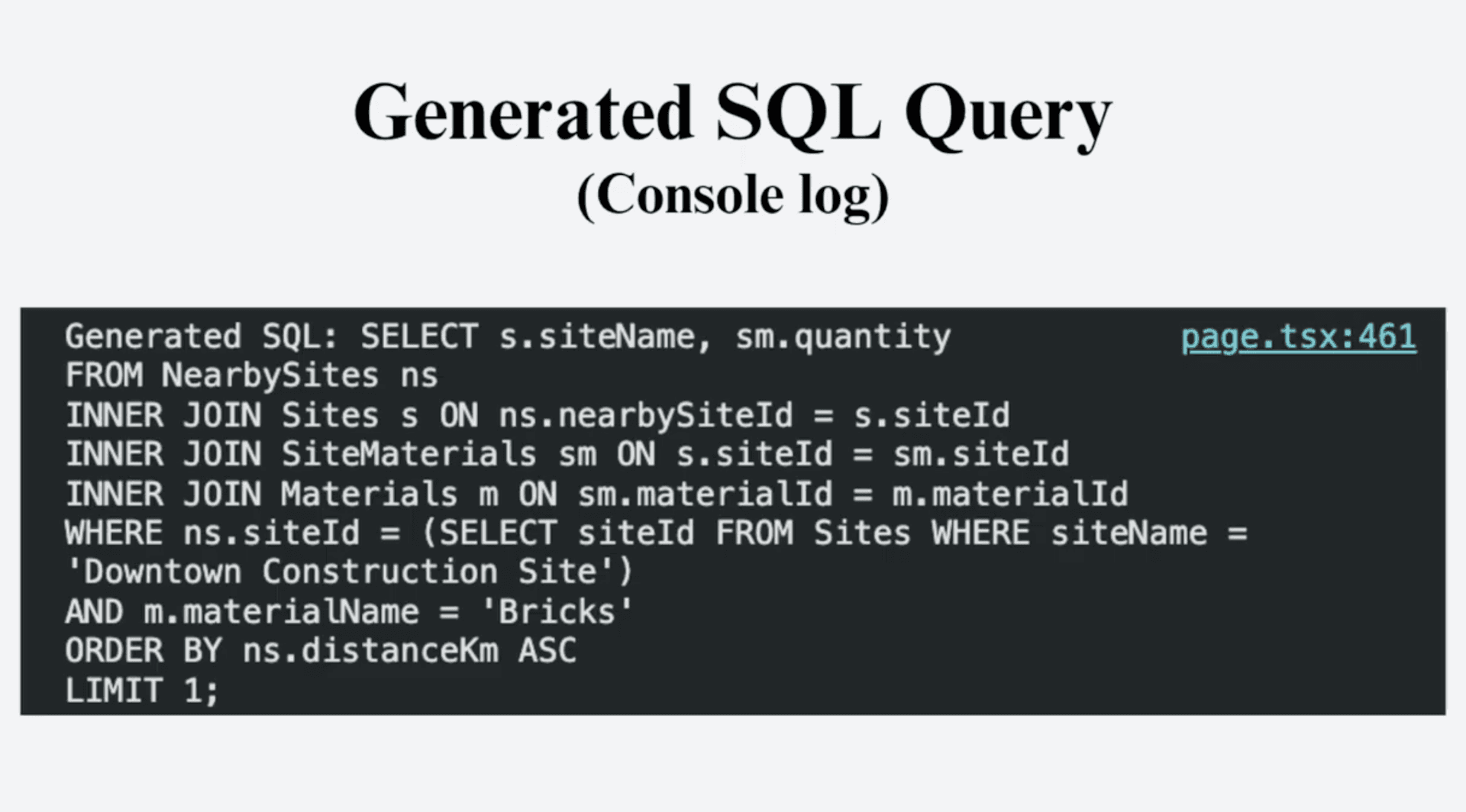
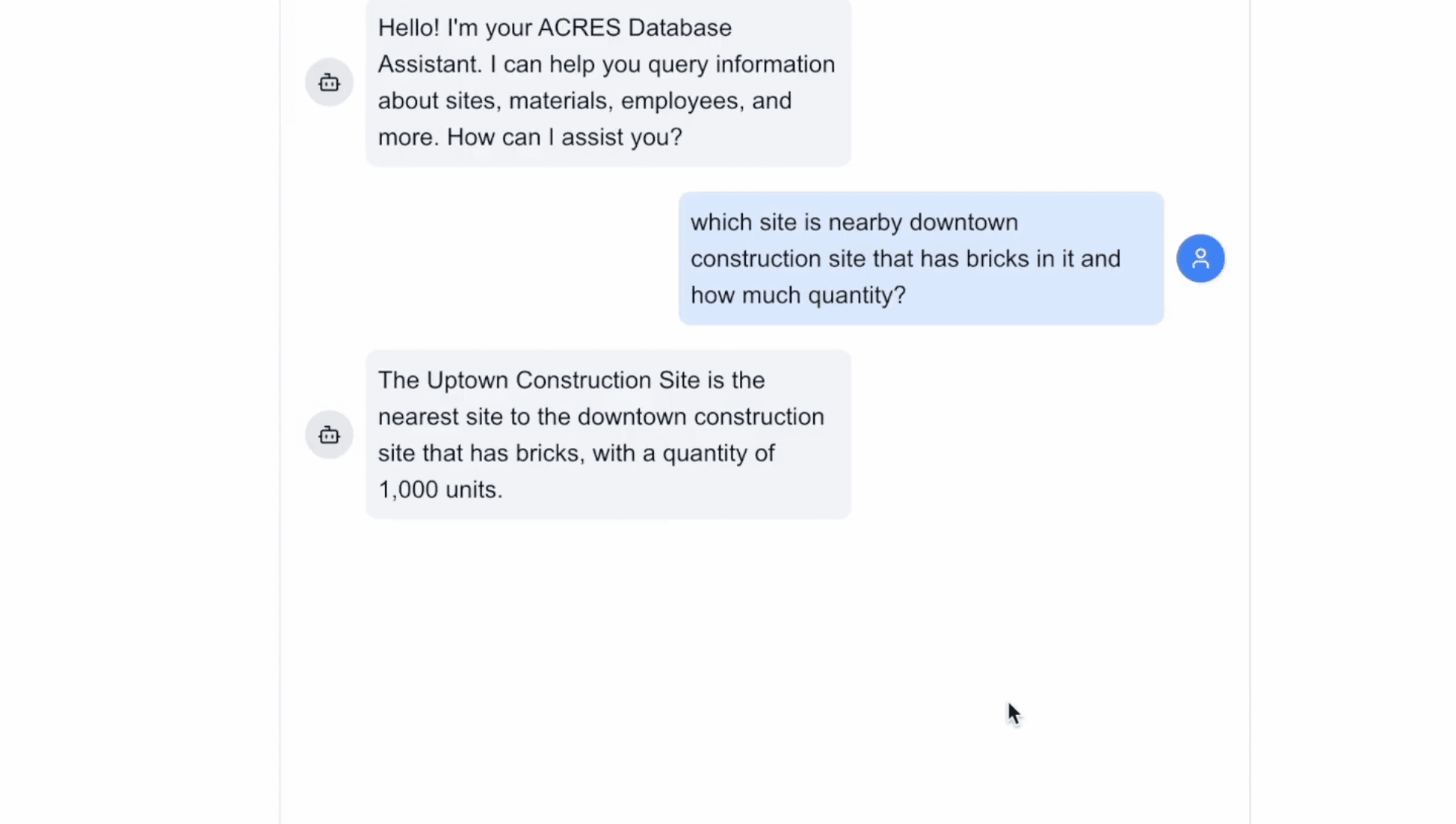
Users query the ACRES Database Assistant in plain English. Questions like "How many employees do we have?", "What materials are needed for the Uptown site?", or "Show me the inventory level for concrete" are translated into precise SQL and executed against the backend database in real time.
This matters operationally because site teams need current answers immediately — not after navigating separate dashboards, digging through spreadsheets, or waiting on a report to be compiled.
Secure SQL Integration
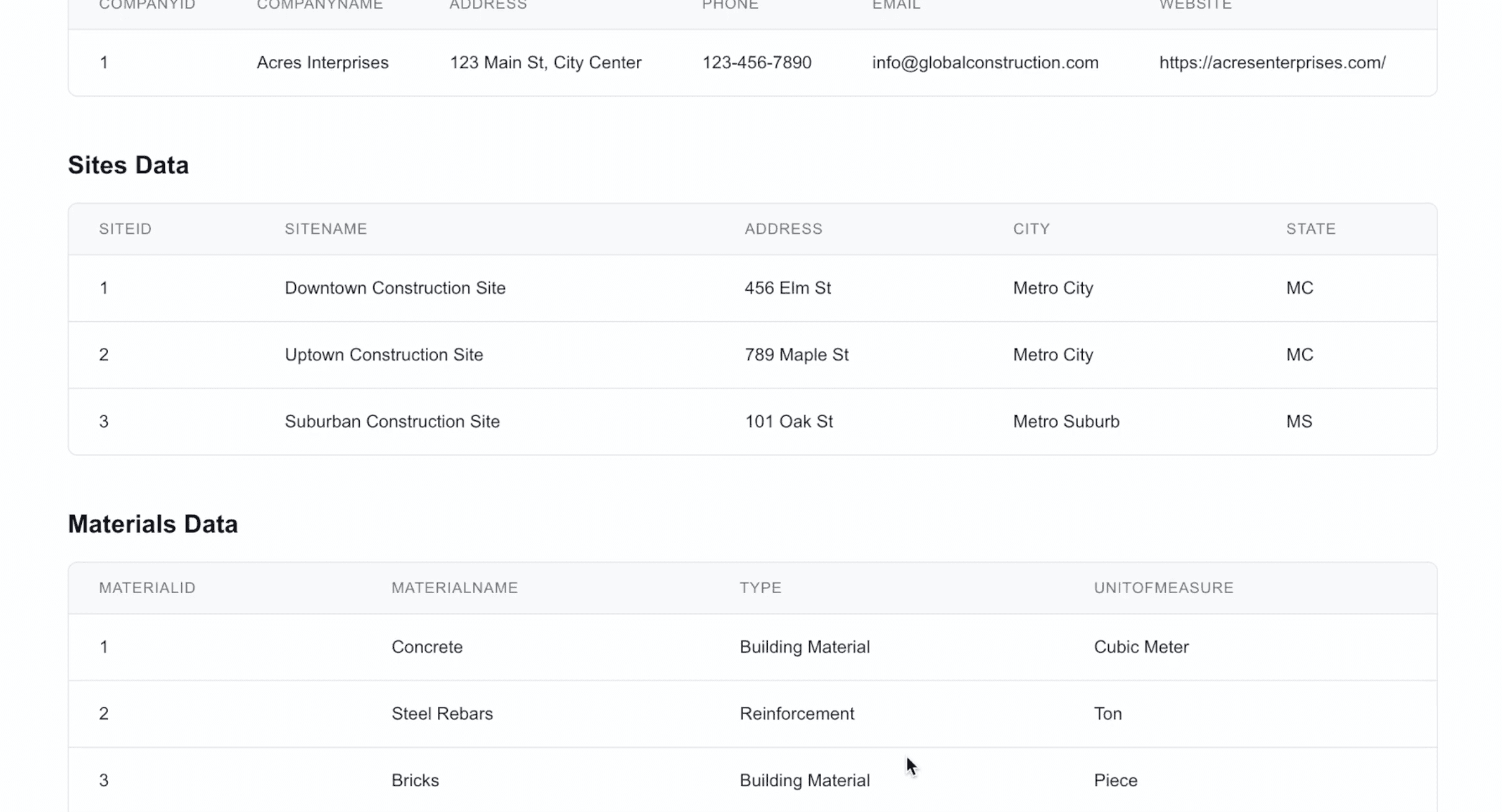
The assistant supports multi-table retrieval for questions such as nearby sites with available inventory, while keeping the raw schema and credentials hidden behind backend mediation.
Instead of exposing the database through external APIs, the AI handles translation internally and returns only the relevant result, improving both usability and security.
// Agentic Workflows
Agentic Coordination
Visual Task Management
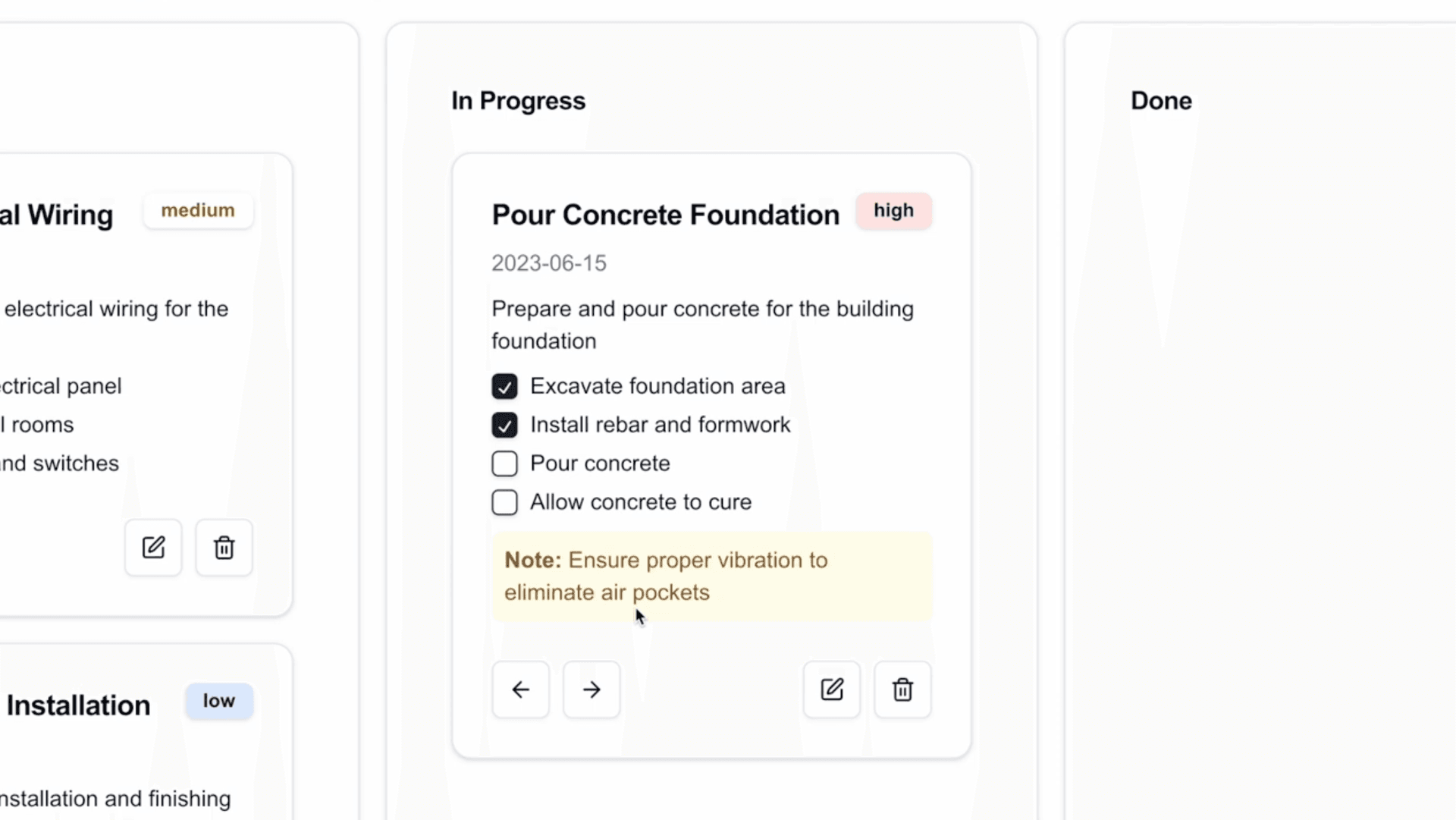
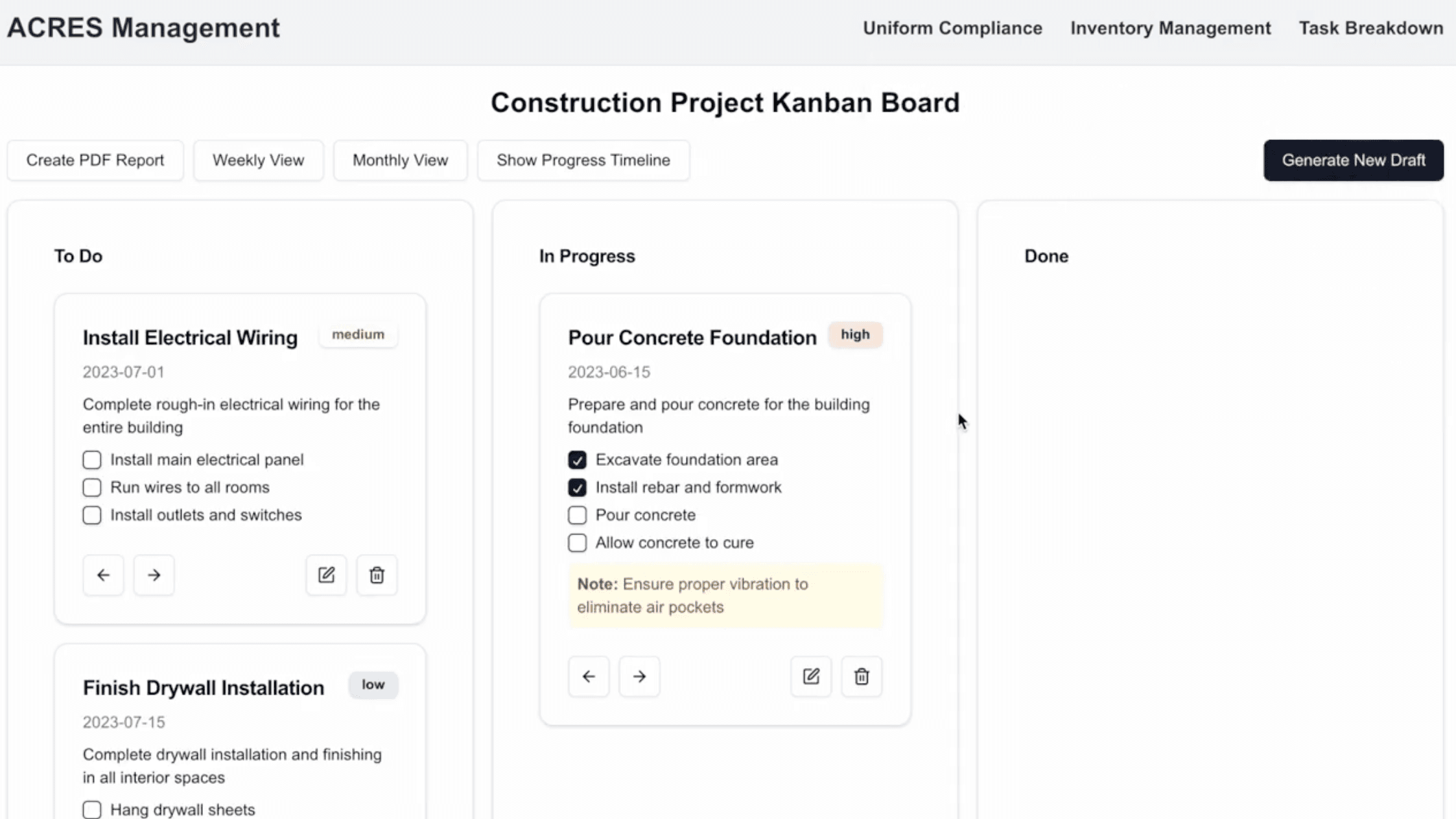
The Kanban workflow organizes work into To Do, In Progress, and Done columns, giving managers a fast visual read on progress across active phases and dependencies.
Each task card carries priority level, due dates, descriptions, subtasks, and specific step-by-step instructions — reducing the chance that critical details get lost between the planning room and the field, especially when handoffs happen mid-phase.
Automated Decomposition
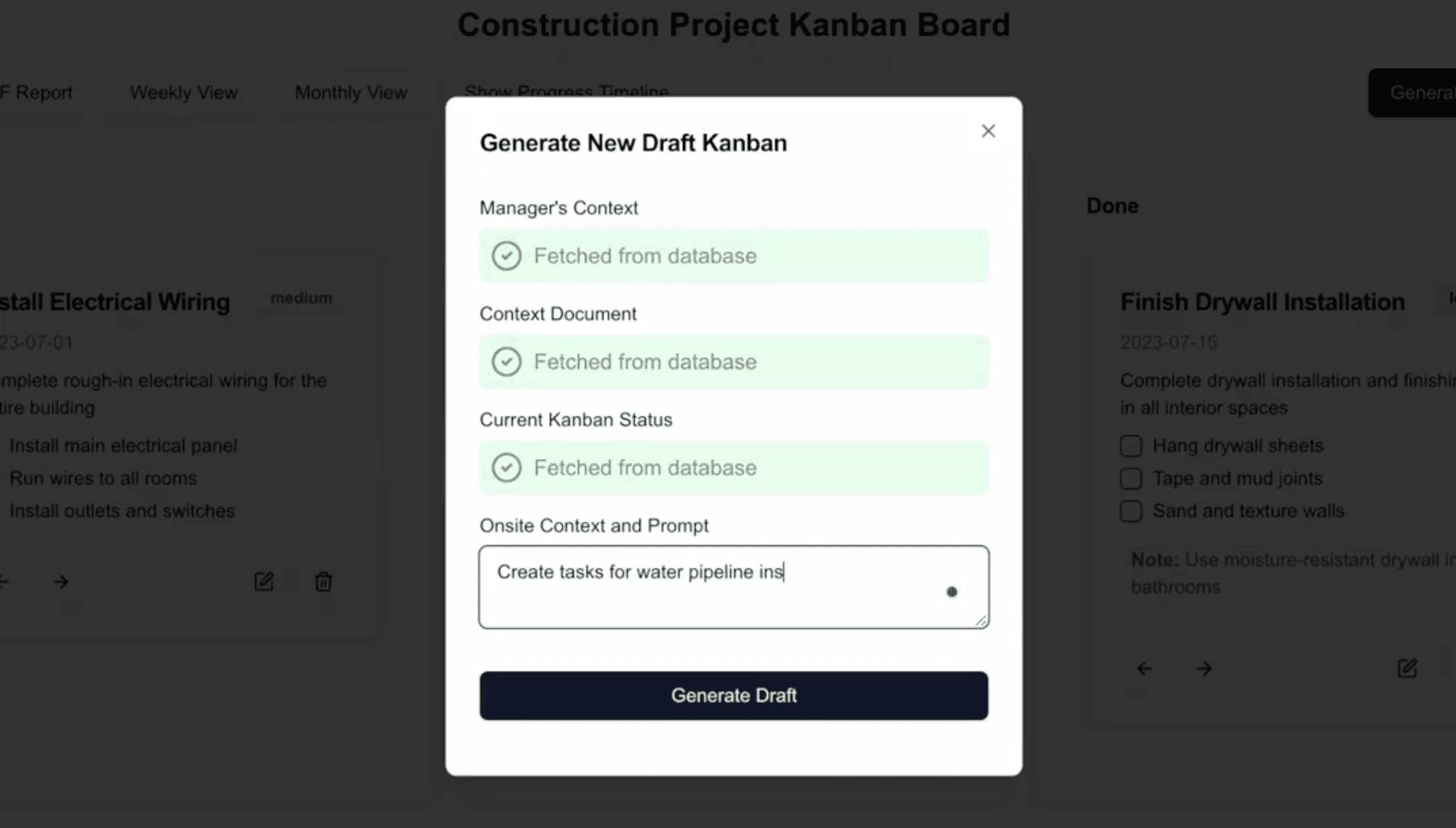
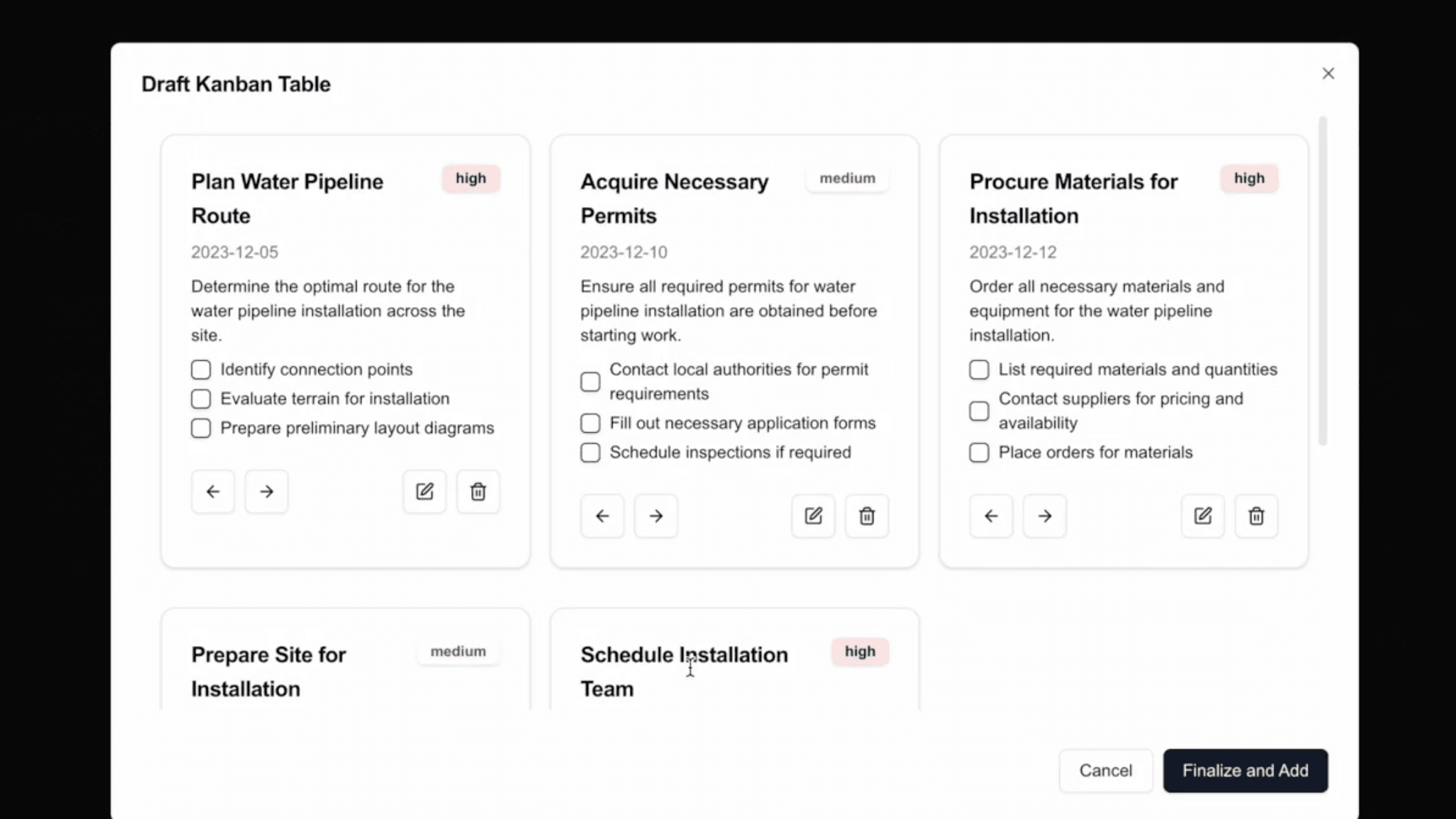
Managers use the AI agent to draft entire job phases by providing job type, site information, quality assurance documents (ITPs), and the current board state. The agent reasons across all of those inputs and produces a structured set of tasks and subtasks ready to drop into the Kanban workflow — covering steps like route planning, permit acquisition, materials procurement, site preparation, and team scheduling.
That saves significant planning time, improves coverage of project requirements, and lowers the risk of missing critical steps when projects move quickly or scope shifts mid-phase.
Intelligent Delegation & Planning
The AI analyzes inputs and breaks down work into logical, actionable tasks and subtasks — Plan Route, Acquire Permits, Procure Materials, Prepare Site, Schedule Team — saving significant planning time and ensuring comprehensive coverage of project requirements, so critical steps are not overlooked when projects move fast or scope shifts mid-phase.
// Engineering
System Intelligence
Under the hood, ACRES had to solve three very different technical problems: computer vision on construction imagery, natural-language-to-SQL translation, and agentic task planning grounded in live project context.
The vision pipeline used pre-trained object detection models fine-tuned on construction site imagery to identify PPE items accurately under varying lighting conditions and partial occlusions. The language layer focused on LLM-driven intent recognition and entity extraction, backed by prompt engineering robust enough to reliably emit structured SQL without hallucinated column names or unsafe commands. The agentic task system used RAG (Retrieval-Augmented Generation) to pull relevant context from ITP documents alongside live board state, then output structured JSON that mapped directly into the Kanban workflow.
The relational data model covered sites, employees, materials, inventory, PPE rules, quality documents, and tasks — all linked across normalized tables. Backend mediation ensured the AI chatbot interacted with the database securely, preventing SQL injection and avoiding any exposure of credentials or schema structure to the frontend or external services.
AI & Machine Learning
- Computer Vision (PPE Detection): Pre-trained object detection models fine-tuned on construction site imagery to accurately identify PPE items under diverse lighting and partial occlusions.
- Natural Language Processing (Chatbot): LLMs for intent recognition and entity extraction, backed by prompt engineering that reliably translates natural language into structured SQL without hallucinated column names or unsafe commands.
- Agentic AI (Task Generation): An agentic framework that reasons across manager input, ITP documents via RAG, and live Kanban board state to produce structured JSON task outputs ready to populate the workflow.
Backend & Database
- Relational Schema: Normalized tables linking sites, employees, materials, inventory, PPE requirements, tasks, and quality documents for efficient cross-entity querying.
- Secure Data Handling: Backend mediation ensures the AI chatbot interacts with the SQL layer securely — preventing injection, avoiding credential exposure, and keeping schema structure hidden from the frontend and external services.
Frontend & Architecture
- React & TypeScript with Next.js: Type-safe, component-based UI delivering interactive experiences across the dashboard, Kanban board, chatbot, and compliance flow.
- State Management: Application state — especially for the dynamic Kanban board and real-time chatbot — handled via appropriate state management patterns to keep UI consistent with backend changes.
- API Integration: Dedicated APIs bridge the frontend with AI inference services, the secure SQL query layer, and task management logic.
// Impact
The Takeaway
Leading ACRES was more than a technical challenge; it was a masterclass in problem decomposition. Combining computer vision, conversational AI, and agentic reasoning taught us how to build cohesive AI ecosystems that solve fragmented real-world problems. The value of this integration was proven when our team secured first place in the AI Hackathon, with judges specifically highlighting the application's unique capability to seamlessly weave together disparate ML architectures into a highly practical B2B tool.
Team Leadership
Leading a technical team under competition deadlines while keeping scope ambitious but deliverable.
System Integration
Integrating vision, NLP, and agentic systems into one coherent full-stack product.
Secure Interaction
Designing secure AI-to-database interaction without sacrificing speed or usability.
Full Ownership
Owning delivery across frontend, backend, and database layers instead of treating them as separate concerns.
Problem Decomposition
Breaking down a broad industry problem into focused product capabilities with real operational value.
Validation
First-place recognition validated both the prototype and the technical sophistication of combining multiple AI systems end to end.